

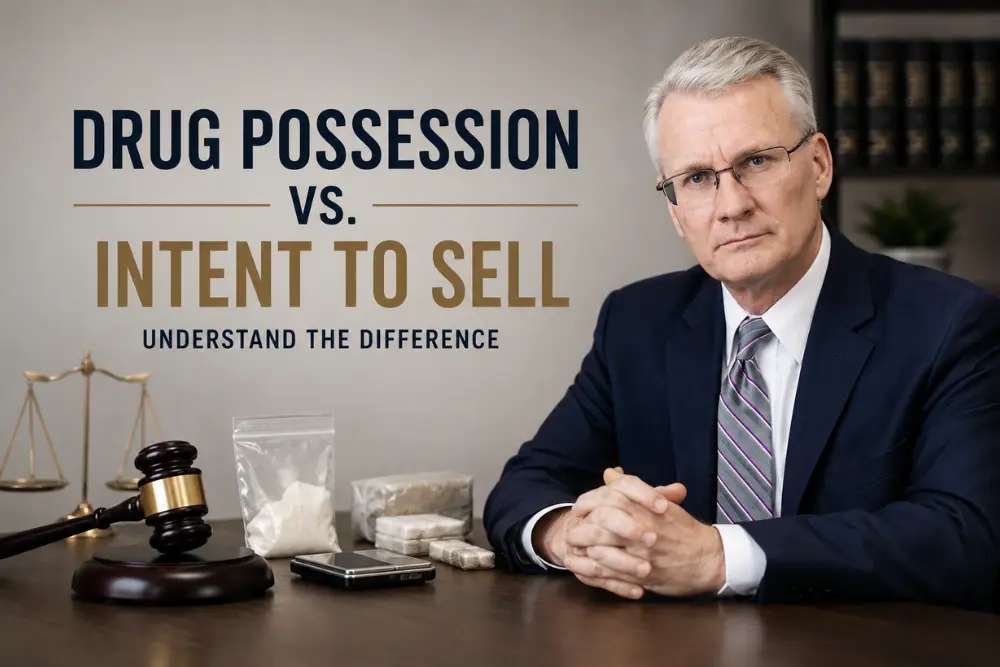
By the Law Office of Robert P. Jarvis | Mesa, Arizona Criminal Defense
Two people can be arrested in the same situation, with the same substance, and similar amounts, and walk away facing charges that are worlds apart. One faces a possession charge. The other faces a felony charge for possession with intent to sell.
The difference between those two outcomes is not always obvious at the time of the arrest. In fact, law enforcement and prosecutors often determine to upgrade a charge based on factors that have nothing to do with whether you actually sold anything to anyone, or ever intended to.
Understanding how Arizona law distinguishes between simple possession and possession with intent to sell can mean the difference between a manageable criminal charge and one that carries mandatory prison time.
Under Arizona Revised Statutes § 13-3405 (marijuana) and § 13-3407 (dangerous drugs, including methamphetamine, cocaine, heroin, and others), simple possession means having a controlled substance for your own personal use — not for distribution, sale, or transfer to others.
Even simple possession is a serious charge in Arizona. Depending on the substance involved, a possession conviction can be:
Under Arizona’s Proposition 200 (the Drug Medicalization, Prevention, and Control Act), first- and second-time non-violent drug possession offenders may be eligible for probation with mandatory drug treatment rather than prison — but this depends on the substance, the amount, the defendant’s history, and whether any other charges are stacked alongside possession.
Simple possession is serious. Possession with intent to sell is a different level of seriousness entirely.
Possession with intent to sell — sometimes called PWITS or possession for sale — is charged under the same statutes as possession, but in a separate subsection that carries significantly harsher mandatory penalties.
Under ARS § 13-3405(A)(2) (marijuana) and ARS § 13-3407(A)(2) (dangerous drugs), it is a felony to possess a controlled substance for sale, regardless of whether a sale actually took place.
The felony classifications for intent to sell are dramatically higher than for possession:
| Substance | Simple Possession | Possession with Intent to Sell |
| Marijuana (under 2 lbs) | Class 6 felony | Class 3 felony |
| Marijuana (2–4 lbs) | Class 5 felony | Class 2 felony |
| Methamphetamine | Class 4 felony | Class 2 felony |
| Cocaine | Class 4 felony | Class 2 felony |
| Heroin | Class 4 felony | Class 2 felony |
| Dangerous drugs (general) | Class 4 felony | Class 2 felony |
A Class 2 felony for sale of dangerous drugs in Arizona carries a presumptive sentence of 5 years in state prison — with a range of 3 to 12.5 years. For repeat offenders, those numbers climb steeply.
And unlike simple possession, Class 2 and Class 3 felony drug sale charges are generally not eligible for Proposition 200 treatment diversion. Prison becomes not just possible but likely upon conviction.
Here is what surprises most people: prosecutors do not need to prove that you sold drugs to anyone. They do not need a witness, a recorded transaction, or a buy from an undercover officer. They need only to prove that you possessed the drugs with the intent to sell them — and they build that case almost entirely from circumstantial evidence gathered at the scene of your arrest.
These are the specific factors law enforcement and prosecutors use to argue intent to sell:
Amount is the most commonly cited factor. The logic is straightforward: people who use drugs personally do not typically carry large quantities. The larger the amount, the stronger the argument that some portion was intended for distribution.
There is no bright-line quantity threshold in Arizona law for most substances — it is not the case that one ounce means possession and two ounces means intent to sell. Prosecutors look at the totality of the circumstances, and quantity is one piece of that picture. But quantity alone, without supporting factors, often isn’t enough for the more serious charge.
This is one of the most powerful indicators prosecutors use. Drugs packaged in multiple small, individual bags or bindles, particularly when the packaging is consistent in size and weight, strongly suggest distribution. A single large bag of the same substance is less suggestive of sales.
If you were arrested with drugs already divided into multiple individual portions, expect the prosecution to argue strenuously for the intent to sell charge.
A digital scale found with drugs is one of the most damaging pieces of evidence in a possession case. Prosecutors often successfully argue that someone buying drugs for personal use does not need to weigh them. Scales are associated with sales because sellers need to measure out individual quantities for customers.
A scale alone is not proof of intent to sell. But a scale combined with a packaged product and large quantities is a combination that prosecutors use in Maricopa County every day.
Cash is not illegal, and carrying cash is not a crime. But a large amount of cash — particularly in small denominations — found alongside drugs is treated as evidence of drug sales income. Prosecutors argue that drug sales generate cash in the denominations customers pay with: twenties, tens, and fives, not hundreds.
Law enforcement routinely requests access to the arrested person’s phone. Text messages referencing transactions, prices, quantities, or meeting locations for exchanges — even if coded in slang — are treated as direct evidence of sales activity. Deleted messages are often recoverable.
Carrying two phones, particularly a basic prepaid phone alongside a personal smartphone, is a flag prosecutors frequently raise. The argument is that separate phones are used to separate drug-dealing communications from personal communications.
If drugs are found with no equipment for personal consumption — no pipe, no syringes, no rolling papers, no residue — prosecutors argue this is consistent with a dealer rather than a user. A user has the means to use. Someone holding product for sale does not necessarily need them.
Statements from informants, neighbors, or other witnesses describing observed sales activity, foot traffic, or transactions are regularly used. Prior arrests or convictions for drug sales are also admitted in some circumstances.
Arizona law adds another layer called threshold amounts. For certain substances, if the quantity possessed meets or exceeds a statutory threshold, the law presumes the drugs were possessed for sale, and the charge becomes a threshold violation with even more severe mandatory minimums.
Current Arizona threshold amounts include:
Possessing drugs at or above these thresholds creates a rebuttable presumption of intent to sell. That means the burden partially shifts — you must offer evidence rebutting the presumption rather than the prosecution having to prove intent from scratch. Threshold violations are charged as Class 2 felonies with mandatory prison time and are not eligible for probation or diversion on a first offense.
This is why a single large purchase of drugs for personal use — particularly methamphetamine or cocaine — can result in a prison-eligible felony charge even if the person had zero intent to distribute.
A charge of possession with intent to sell is not a guaranteed conviction. These cases rest heavily on circumstantial evidence, and circumstantial evidence can be challenged, contextualized, and sometimes dismantled entirely.
Challenging the search. If the drugs were found during a search of your vehicle, home, or person, the first question is whether that search was constitutionally valid. Unlawful searches under the Fourth Amendment produce suppressed evidence. No evidence, no case. This is one of the most productive areas of defense in drug cases.
Contesting the intent inference. Possessing a scale does not prove you sold drugs. Possessing multiple bags does not prove you sold drugs. Defense attorneys challenge each piece of circumstantial evidence the prosecution uses to build the intent argument, forcing them to prove their case element by element rather than on impressions.
Disputing ownership. In cases where drugs were found in a shared space, a vehicle with multiple occupants, or a shared apartment, the prosecution must prove that you knew the drugs were there and exercised dominion and control over them. This is called constructive possession, and it requires proof, not assumption.
Negotiating charge reduction. In many cases, particularly for first-time offenders or where the evidence of intent is weak, an experienced defense attorney can negotiate with the Maricopa County Attorney’s Office to reduce an intent to sell charge down to simple possession, a significant reduction in both exposure and long-term consequences.
The decision to charge someone with simple possession versus possession with intent to sell is often made in the hours immediately following an arrest. In some cases, prosecutors upgrade charges days or weeks later as they review the evidence package.
Either way, having an attorney involved from the earliest possible moment, ideally before you speak to anyone, maximizes your options and minimizes the risk that a manageable situation becomes a life-altering one.
The Law Office of Robert P. Jarvis represents clients throughout Mesa, Chandler, Gilbert, Tempe, and Maricopa County in drug possession and drug sales cases at every stage — from arrest through trial. We examine every search, every piece of alleged evidence, and every prosecutorial decision in your case.
Call today for a free, confidential consultation: [INSERT PHONE NUMBER]
The charge you face today is not necessarily the charge you have to live with.
The Law Office of Robert P. Jarvis serves clients in Mesa, Chandler, Gilbert, Tempe, Scottsdale, and throughout Maricopa County. This article is for general informational purposes only and does not constitute legal advice. Drug laws and sentencing guidelines are subject to change — contact our office for guidance specific to your situation.